REMS Research Coordination Network
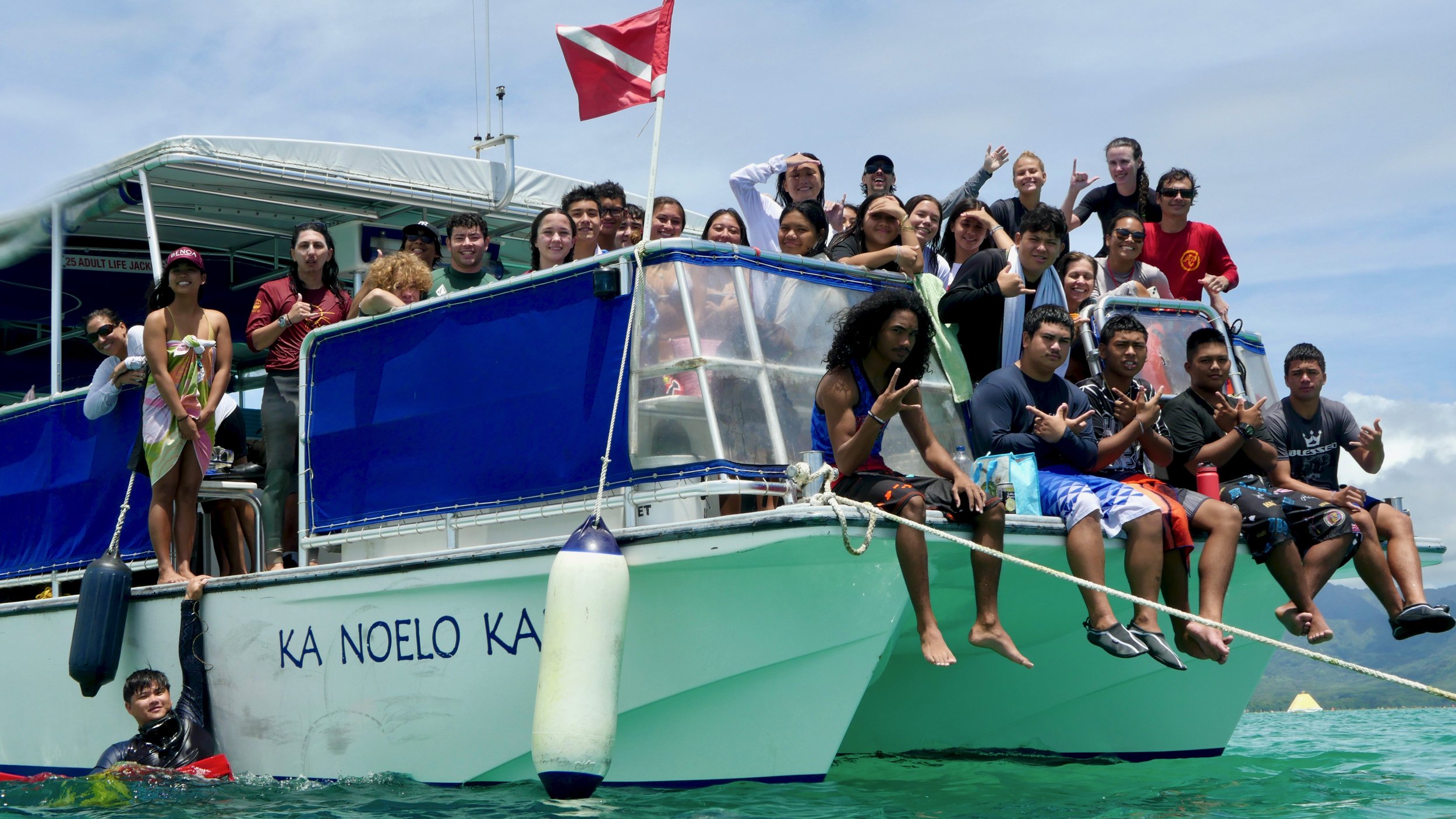
The REMS Research Coordination Network (RCN) was a NSF-funded initiative that supports a network to build and strengthen undergraduate STEM pathways via the development of a cumulative, immersive, course-based undergraduate research experience (CURE) in Hawai'ʻi: the Research Experiences in Marine Science (REMS) Program.
The goals of the network were 1) to conduct a series of workshops and meetings to facilitate knowledge exchanges among network partners and outline network needs, 2) create and pilot novel modules for the REMS curriculum, and 3) develop detailed plans for expanding and sustaining the program.

The map above highlights some of the Windward Oʻahu campuses and field sites participating in the REMS network. Located on an islet called Moku o Lo‘e in Kāne‘ohe Bay off the island of O‘ahu is the host campus: the Hawai‘i Institute of Marine Biology (HIMB). HIMB is an ideal setting for immersive research education and engaged student learning. Moku o Lo‘e itself is surrounded by 64-acres of fringing coral reef designated as the Hawai‘i Marine Laboratory Refuge. HIMB’s state-of-the-art facilities, combined with its unique location and proximity to estuarine, coastal, and offshore environments promote the integration of cutting-edge laboratory experimentation, rigorous fieldwork, and science education. Although the host campus and REMS curriculum are based within the ahupuaʻa (Native Hawaiian socio-ecological land division) o Heʻeia, partner programs and network members represent the diverse communities and geographies of Oʻahu and the broader Pacific.
RCN Project Outcomes
-
•Partnered with the Johansen Lab at HIMB to develop a new module examining sedimentation impacts on fish foraging behavior
•Kekai Perry and Mari Quinn developed and piloted module to support the growth of students as leaders in scientific and civic service with REMS XL (virtual) and REMS 2024 (in-person)
•Re-piloted the HIMB Center for Community Education evening plankton lab activity during REMS
-
•November 17, 2023: HIMB and KVA hosted activities for immersive undergraduate research experiences; pedagogy and curricula for Hawaiʻi’s students
•April and June 2024: Piloted novel module to support student leadership skill development
•June 12, 2024: Evening plankton activity; Hawaiian star navigation
-
April 19, 2024: Kānehūnāmoku Voyaging Academy intern teaching rotations/evaluations
June 6, 2024: REMS XL and mentor/instructor pilina (relationship)-building and laulima (community work) with Paepae o Heʻeia
June 11, 2024: REMS 2024 cohort pilina-building and laulima with Waikalua loko iʻa
-
June - July, 2024: 24 students (18 new students and 6 REMS alumni acting as near-peer mentors) participated in the 6-week research intensive at HIMB.
Graduate student instructors earned credits in newly created teaching courses through the University of Hawaiʻi at Mānoa: MBIO 695 and MBIO 795
June 11 - 14: REMS hosts scholars representing the Indigenous STEAM program and POLARIS
July 18, 2024: Students presented their projects at the REMS Research Symposium
-
October 2024 - Network members publish an article on student gains in a course-based undergraduate research experience (CURE) focused on marine science highlight the importance of immersive learning and its impact on students in Hawaiʻi entering undergraduate pathways:
Ambrosino, C.M., Gorospe, K.D., Limeri, L.B., Correa-Garcia, S., & Rivera, M.A.J. (2024). CBE: Life Sciences Education, DOI: 10.1187/cbe.24-02-0038
Evaluation Report
The evaluation team for this project, led by external evaluator Umi Jensen, Co-PI Summer Maunakea, and REMS staff Christine Ambrosino, developed a logic model to identify the strands of activities, outputs, and outcomes related to these goals and to inform evaluation planning. The resulting evaluation plan aimed to gather feedback from REMS network partners and students after professional development workshops, laulima days, and the summer program. The full report may be accessed by network members via the Evaluation Report button (access to the report is currently limited to network members while results are prepared for publication, but will be updated as additional reports and articles develop).
In summary, this evaluation found that REMS network members value participating in REMS, connecting and reconnecting with one another, and sharing knowledge and teaching strategies. Network partners are passionate about REMS and marine science education, recognize challenges they face, and see the potential of REMS and the REMS network to support students in marine sciences. Students are also passionate about their learning in the program and have grown their understanding and confidence in marine science and scientific research and their interest in marine science and STEM for their careers. Interviews with two REMS alumni and recent peer mentors provided insights into the impact of Hawaiʻi-focused early-college STEM opportunities and the potential of these programs to prepare students for college and career, both academically and socially. The evaluation was also able to glean lessons learned in Hawaiʻi Early College STEM from network partners who recognized the need to build awareness of marine science and STEM pathways.
REMS RCN Project
PI-Team and Steering Committee
-

Malia Rivera, Ph.D.
Principal Investigator
Hawaiʻi Institute of Marine Biology, School of Ocean and Earth Science and Technology
University of Hawaiʻi at Mānoa
-

W. Kekailoa Perry, J.D.
Co-PI
Educational Foundations, College of Education
University of Hawaiʻi at Mānoa
-

Summer Maunakea, Ph.D.
-

Christine Ambrosino, Ph.D.
Project Coordinator
Hawaiʻi Institute of Marine Biology, School of Earth Science and Technology
University of Hawaiʻi at Mānoa
-

Herb Lee, Jr.
Waikalua Aquatic Institute
Pacific American Foundation
Website -

Bonnie Kahapeʻa-Tanner
Kānehūnāmoku Voyaging Academy
Website -

Mackenzie Manning
Windward Community College
Website -

Shimi Rii, PhD
Heʻeia National Estuarine Research Reserve
Website
RCN Partner Programs
-
Malia Rivera, Ph.D.
Faculty Specialist and Professor, graduate faculty in both Marine Biology and Curriculum Studies with specialization in molecular systematics, marine population genetics, marine science curriculum development and education research.
Role – PI, new curriculum development, overall network and project coordination
Christine Ambrosino, Ph.D.
Senior Personnel, with specialization in education research, curriculum development, neuroethology and shark sensory biology.
Role – REMS program coordination and lead instructor, contributes to guiding assessment activities and continued development of new aspects of REMS curriculum and website development.
-
Summer Maunakea, Ph.D.
Assistant Professor, with specialization in place-based and Indigenous land-based education research and culturally relevant evaluation and assessment.
Role – Co-PI guiding place-based evaluation and community building efforts within a culturally responsive framework and advising on place-based pedagogies. Leading coordination with External Evaluator.
Margaret Maaka, PhD.Professor, with specialization in Indigenous education, educational policy and psychology.
Role – informing education and networking endeavors through Indigenous methodological frameworks and facilitating coordination with external networks.
-
W. Kekailoa Perry, J.D.
Associate Professor with specialization in law, race and culture and the practical application of those subjects through advocacy.
Role – Co-PI strengthening community connections in the practice of scientific research via discourse with students on environmental and cultural stewardship advocacy.
-
K. Laiana Wong, Ph.D.
Professor and graduate faculty in Curriculum Studies, with specialization in Hawaiian language revitalization and Hawaiian world view.
Role – strengthening a Hawaiian worldview in the practice of science via ʻŌlelo Hawaiʻi.
-
Jenna Komatsu
Early College Coordinator and Assistant Director of Summer Sessions for the University of Hawai‘i at Mānoa
Role – coordination, administration and enrollment of REMS related UHM courses associated with the network.
-
Janis Dela Cruz
METS Program Director
Role – recruiting and supporting early college students into/in REMS and RCN supported pathways targeting Title I schools in rural West O‘ahu.
-
Edmond Lee
Gear UP Mānoa Director
Role – recruiting and supporting early college students into/in REMS and RCN supported pathways targeting Title I schools in rural Central O‘ahu
-
Nicole Atwood
Early College Program Director for Hawaiʻi P-20, a statewide partnership led by the Executive Office on Early Learning, the Hawai‘i State Department of Education, and the University of Hawai‘i System
Role – strengthening the education pipeline to postsecondary education and training through network related early college programs.
-
Herb Lee Jr.
CEO and President and Derek Esibill, Lead Instructor of an early college course Kilo Kai (SCI 295) at UH Windward Community College (WCC).
Roles – recruiting early college students into REMS pathways targeting Title I schools in rural Windward O‘ahu and facilitating culturally relevant research and laulima at Waikalua Loko I‘a.
-
Yoshimi Rii, Ph.D.
Research Coordinator and MBGP graduate faculty, and Fred Reppun, Education Coordinator.
Roles - facilitating place-based and culturally relevant research and laulima (community based environmental restoration work experiences) within the He‘eia NERR, including the Loko I‘a o He‘eia, and expanding REMS RCN to He‘eia NERR related education networks.
-
Bonnie Kahape‘a-Tanner
Director and Mahealani Treaster, Project Coordinator.
Roles – recruiting early college students into REMS pathways targeting a Hawaiian focused public charter school on O‘ahu, part of an early college undergraduate course in Hawaiian Voyaging (Hawaiian Studies 110) at WCC, and facilitating place-based and culturally relevant research within Kāne‘ohe Bay.
-
Megan Donahue, PhD.
HIMB Research Professor and Co-Director of the UH Mānoa Marine Biology Graduate Program.
Role – facilitating creation of new graduate level courses anchored in REMS curriculum to train graduate students in place-based marine science teaching and pedagogies.
-
Rosie Alegado, Ph.D.
Associate Professor of Oceanography and UH Sea Grant College Program, Co-PI of the Hālau Ola Honua Partnership funded by NSF PAGE, a multi-institutional collaboration between UH Windward Community College, Honolulu Community College, Kaua‘i Community College and UHM and PI of the SOEST Maile Mentoring Bridge Program.
Role – facilitate transitions of early college REMS students to SOEST undergraduate courses such as the place-based Oceanography 201 summer bridge course and broader SOEST undergraduate degree programs.
-
Mackenzie Manning
Professor of Biology and Marine Biology and MOP coordinator.
Role – REMS senior instructor and curriculum developer, facilitation of early graduate students transitioning to community college within the UH system and advising on prospective MOP Certificate pathways for UH Community College students that matriculate through REMS programs.
-
Bradley ‘Kai’ Fox Ph.D.
UHSG Aquaculture Extension Specialist and Principal Investigator of the Waikalua Aquatic Institute, a collaboration between the Pacific American Foundation and UHSG to conduct restoration research on pua (juvenile fish) and limu (edible seaweed) production at Waikalua Loko I‘a and for eventual outplanting at Loko I‘a across the Hawaiian Islands.
Role – support REMS students conducting place-based, community driven fishpond aquaculture research at Waikalua Loko I‘a.


